
In 415 BC, a powerful Athenian fleet sailed for Sicily. It proved to be a critical moment in the 27-year-long Peloponnesian War between the Athenians and the Spartans, which would decide who would dominate the Greek world. Thanks in large part to the detailed account by Thucydides, the Sicilian Expedition became one of the most famous episodes of an era-defining conflict. It raises questions about foreign entanglements, democracy, and imperial ambitions.
The Sicilian Debate
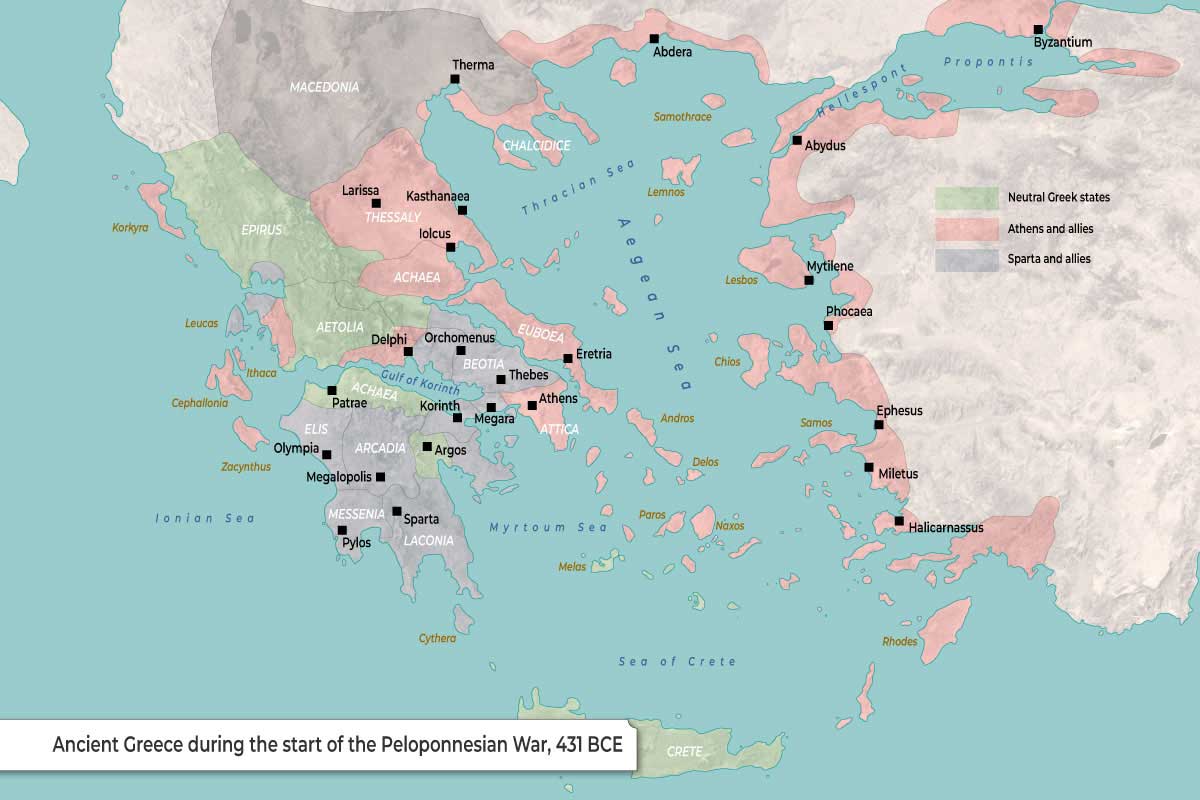
The Athenians have often been criticized for sailing to Sicily when their long-running conflict with the Spartans was still unresolved. Thucydides (6.1), the contemporary Athenian general turned historian, was clear that the expedition aimed to conquer the whole island. Though exiled at the time, he thought that the Athenian democracy acted out of ignorance and ambition. But was the move driven by the events of the day, or motivated by deep-seated ambition?
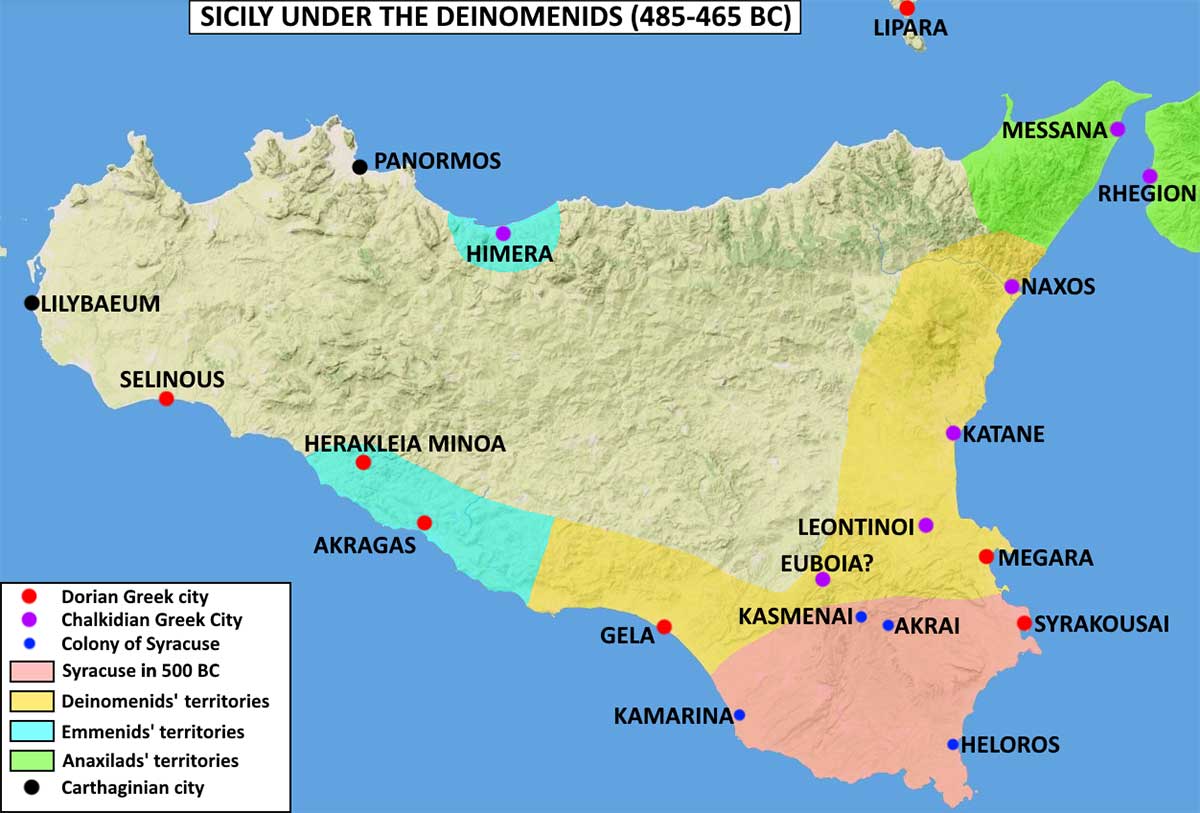
The expedition was directly caused by Sicilian politics. Two communities, Leontini and Segesta, were threatened by Sicily’s largest city, Syracuse, and its allies. Desperate for aid, they sent envoys to Athens. The Athenians had already sent modest expeditions to Sicily to assist allies between 427 and 424 BC. Having achieved little, these Athenian forces withdrew when the Sicilian communities reached a peace in 424 BC. Now, in 415 BC, they were being called back. The Athenians were cautious rather than jumping at the opportunity. Envoys went back and forth, and the Segestans resorted to deception to convince the Athenians that they could cover their expenses.
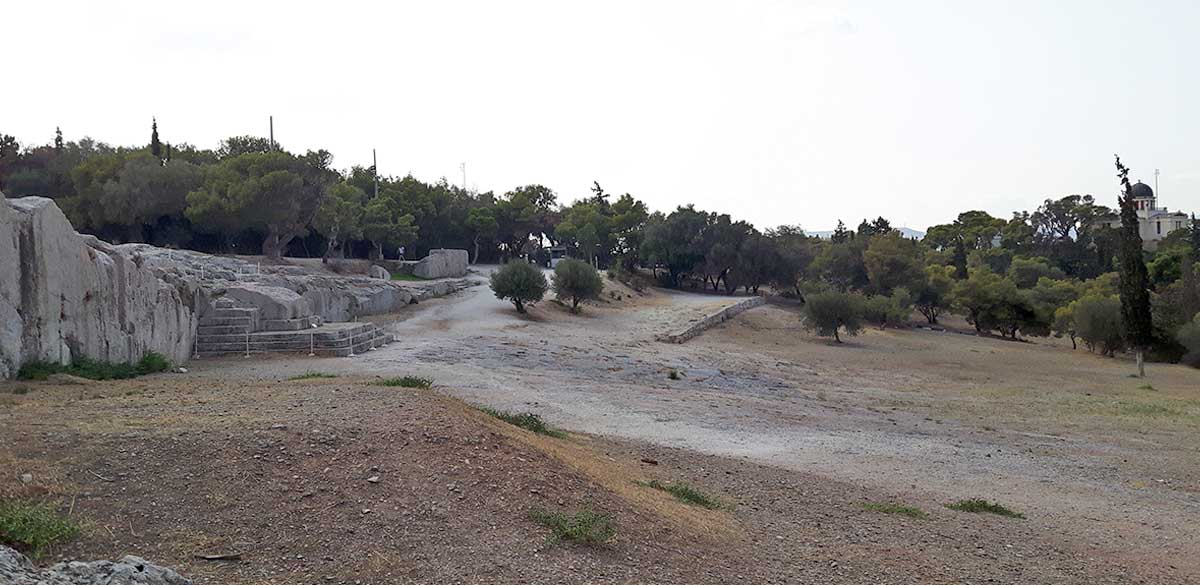
In 415 BC, the Athenian assembly debated the Sicilian question. In favor of sending aid was the young rising star of Athens, Alcibiades. So far, his career had shown aggression and ambition, though only limited success. He was opposed by the elderly, cautious, and experienced Nicias. The debate went Alcibiades’ way, and the Athenians voted to dispatch a fleet of 60 ships. This was a defeat for Nicias, even though he was appointed one of the expedition’s generals. The size of the fleet was in line with previous missions and does not appear especially ambitious. It was Nicias’ next step that set Athens on the road to disaster.
At the assembly to discuss the mission’s details, Nicias reopened the debate. Failing again, he changed tactics. He tried to scare the assembly by advising that a much greater and more expensive fleet was needed. Instead of refusing the extra costs, the assembly called his bluff and voted to increase the size of the expedition. Nicias had inadvertently turned a limited mission into a major and risky undertaking.
Ambition and Ambiguity
Thucydides’ account does not back up his claim about Athens’ having grand, ill-informed ambitions in Sicily (Kagan 1981, 165). They had taken their time and initially decided on a moderate response. Unpredictable events raised the stakes.
Thucydides is clearly correct that the Athenians were an ambitious and aggressive community. During their rise to prominence in the 5th century BC, the Athenians had shown a taste for distant military adventures in Cyprus, Egypt, and Italy. With a precarious peace with the Spartans in place since 421 BC, and having recovered somewhat from the losses of the war’s first decade, the Athenians were likely willing to look out again. Conquest of Sicily may not have been the initial aim, but should the opportunity present itself, many Athenians would take it. How practical that would be is a different question, but it would have made some strategic sense. Sicily was a large, rich island. While the Athenians had some Sicilian friends, the largest city, Syracuse, even though it was a democracy, had links to the Peloponnesians. Should it ever enter the war in Greece, it would be on the Spartan side.
The Athenians may have fared better had they genuinely aimed at conquest from the beginning. The goal of the expedition was to aid Athens’ allies. That implied war with Syracuse, though the stated orders were open to interpretation, while the inflated fleet increased the risk of the gamble. The ambiguity of the venture would hamper the Athenians’ efforts.
An Ill-Omened Beginning
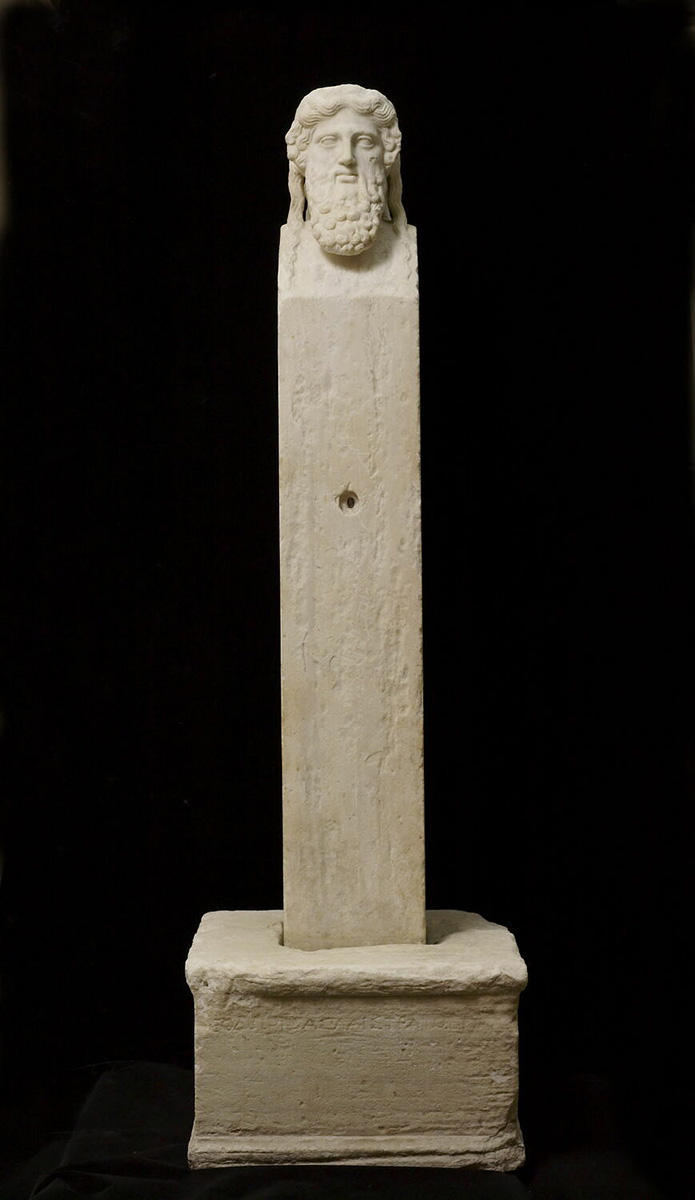
As the Athenians were loading their ships in mid-415 BC, the city was shocked by a series of sacrilegious acts. One night, an unknown group of people roamed through the city vandalizing the sculptures known as Herms. These short columns, often marked with the head of a god, frequently Hermes, stood at prominent locations such as crossroads. With Hermes associated with travelling, the act was clearly aimed at the expedition and was troubling from a political as well as religious point of view (Kagan 1981, 194).
With Athens in uproar, further rumors surfaced. Some elite groups had committed other sacrilegious acts by conducting mock ceremonies of one of Athens’ most sacred rites, the Eleusinian Mysteries. This time, Alcibiades, who had been appointed one of the expedition’s commanders, was implicated. He called for an immediate trial, hoping to clear his name before leaving, but his many opponents delayed it. One of the expedition’s main supporters and generals sailed away with capital charges hanging over his head.
Though it left under a cloud, the force that left Athens in summer 415 BC was impressive. Thousands of sailors manned 134 trireme warships. The triremes and transport ships carried 5,100 hoplite heavy infantrymen and over a thousand light-armed troops. Joining Nicias and Alcibiades in command was the experienced general Lamachus. The three generals were an odd mix of ambition, experience, and reluctance, but they were skilled commanders and diplomats.
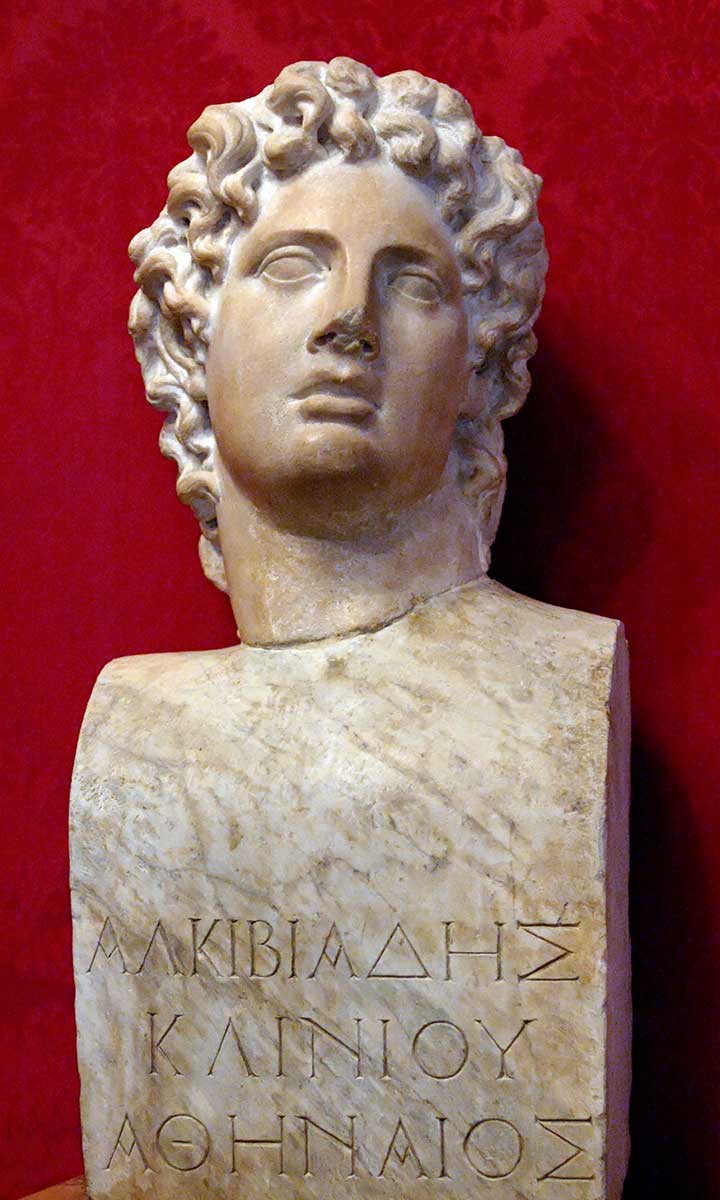
Upon arriving in Sicily, the three generals each proposed a different plan. Nicias, having failed to stop the expedition, wanted to cut it short. He suggested sailing around the island to demonstrate Athens’ power before leaving a smaller force with the allies and sending the rest straight home. Alcibiades wanted to build a network of alliances, paving the way for a sustained Athenian presence. Lamachus argued that while their force was at its peak and its enemies unprepared, now was the time for a direct strike at Syracuse. Modern scholars look favorably on Lamachus’ strategy (Kagan 1981/Hansen 2005), but he seemed to have lacked authority with his colleagues and had to side with Alcibiades.
Quickly, the fleet proved ill-suited for this approach. A sizeable Athenian force suddenly showing up may have overawed some, but was worrying for many. Consequently, the Greek cities of southern Italy were reluctant to cooperate. The trend continued in Sicily. Worse, not long after Alcibiades got to work, with very limited success, he was ordered to return to Athens to stand trial. Not having much faith in the Athenian courts, he instead slipped away and defected to Sparta.
The Siege of Syracuse
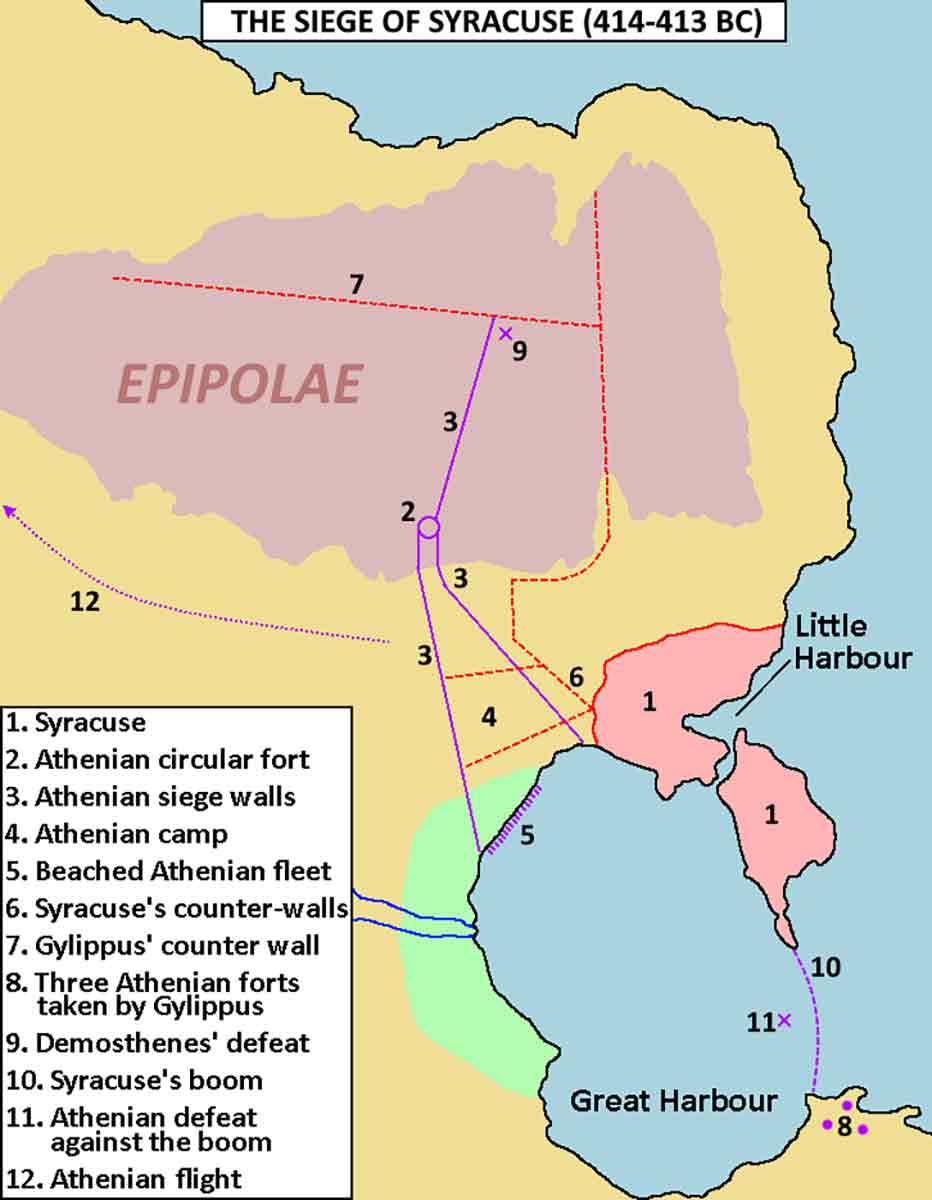
Much of 415 BC was wasted. Few allies came forward, and existing allies did not provide the promised funds. Late in the year, Nicias decided to move on Syracuse, but despite winning a battle outside the city walls, the Athenians withdrew back to their base. The expedition was at least now fixed on a definitive purpose, the siege of Syracuse.
Both sides took the winter to prepare. The Syracusans looked to Athens’ enemies in Greece. The Athenians noted that they were unable to exploit their victory outside the walls because of the Syracusan cavalry. Few horsemen had sailed from Athens, and Nicias now belatedly assembled a force. By early 414 BC, the great siege of Syracuse began.
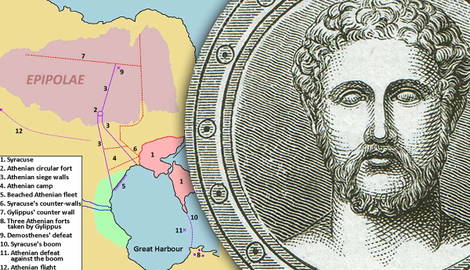
The key to taking Syracuse was the patch of high ground and cliffs in front of the city to the west, known as Epipolae. The Athenians needed control of Epipolae to complete a wall to seal Syracuse off. The Syracusans, especially the cavalry, harassed the Athenians and started construction of their own counter-walls. However, the Athenians won many of these skirmishes, though Lamachus was killed in one battle, tightening the noose.
Nicias has been criticized for moving too slowly to finish the walls and complete the blockade (Kagan 1981, 273), but it may be that the Athenian force was too small for the task. During this phase, the Athenians could focus on construction or defeating the Syracusan attacks, but not both at the same time. Too large for diplomacy, too small to take Syracuse. The ambiguity of the Athenian expedition again hampered it.
While the Syracusans could only delay the Athenians, they had survived just long enough. Several months into the siege, the Syracusans were nearly surrounded and were talking of surrender. At just this moment, Peloponnesian and Spartan aid arrived. A Spartan officer named Gylippus slipped past an unobservant Nicias and marched a small relief force through the unfinished section of the siege wall. The morale boost was enough for the Syracusans to renew the battle around Epipolae. In the end, it was the Syracusans who finished their construction first, as they completed a counter-wall which stopped Athenian progress and kept a route to the city open.
Rolling the Dice
Syracuse remained in a precarious position, but the Athenians were losing the initiative as 414 BC ended. Nicias reported back to Athens that not only was he himself ill and in poor condition to continue, but that the expedition needed either recalling or reinforcing. Unwilling to give up now that they had committed so much, the Athenian assembly voted to prepare a relief force under Demosthenes and Eurymedon.
The second armada amassed another 70 ships and 5,000 hoplites. The combined force of over 200 ships and more than 40,000 men represented around half of Athens’ total strength (Hansen 2005). A great deal of Athens’ power now rested on victory in this controversial expedition.
Once the relief force arrived in 413 BC, Demosthenes saw that the situation needed quick, decisive action. Epipolae remained the key, but attacking the high ground was extremely difficult. In a bold and rare move in ancient warfare, the Athenians decided on a night attack. After a promising start, they got confused and lost in the darkness. Unable to tell friend from foe, the attack stalled and then failed. As many as 2,000 Athenians died, the largest losses of the campaign so far.
Following the defeat, Demosthenes argued for abandoning the siege, but Nicias hesitated, claiming the city was still about to surrender. Most likely, he feared returning to Athens in defeat. The arrival of further reinforcements for the besieged finally changed his mind, but then the gods intervened with a lunar eclipse. Piety was a key element in Nicias’ personality and public image, and he took this as a bad omen and refused to start the retreat. The delay proved fatal.
Battle in the Great Harbor
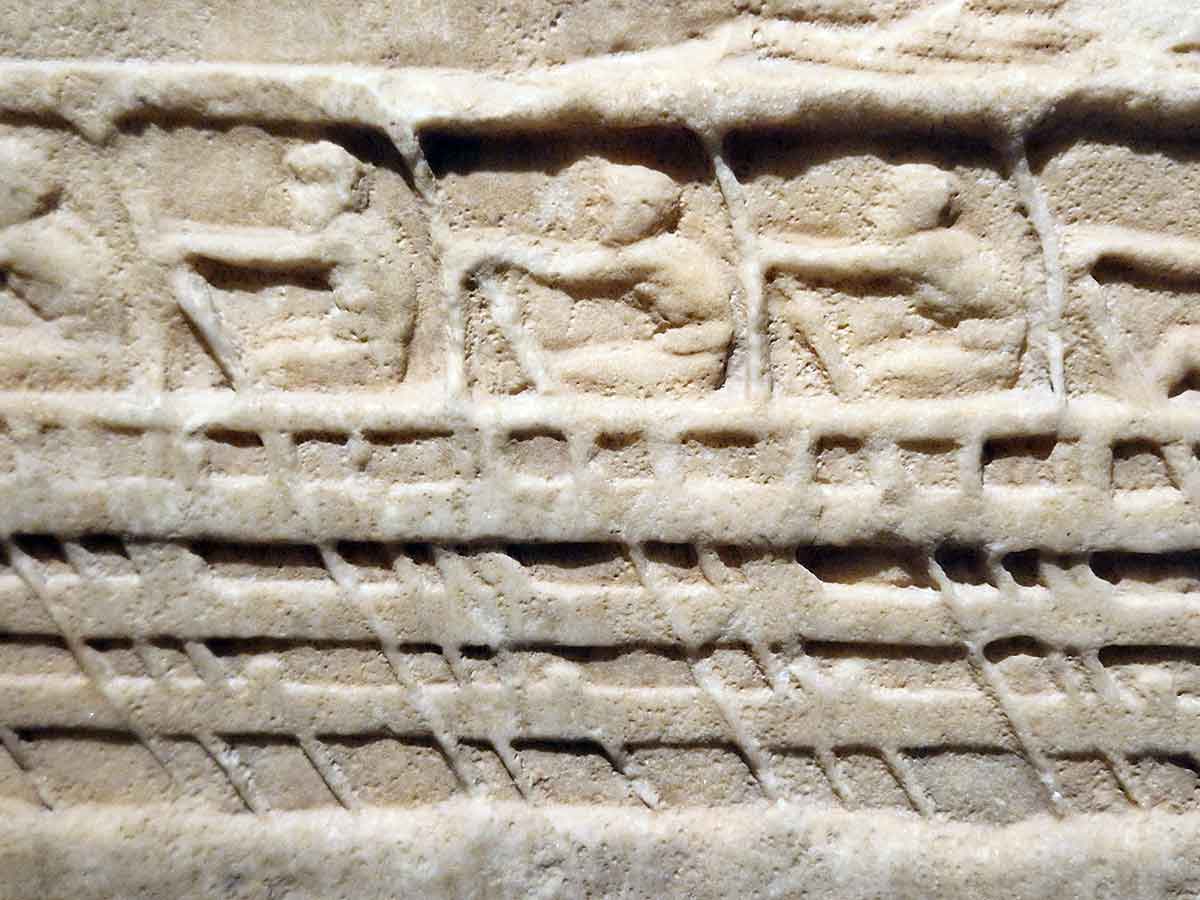
Giving up on victory on land, the Athenians now had to fight for their lives at sea. Athens was a maritime power with the largest and most skilled Greek fleet. However, wooden triremes need constant maintenance to stay at sea, and while Demosthenes’ ships were fresh, much of the fleet was not in top condition. Moreover, the Syracusans had been preparing and improving their fleet. Corinth formed the backbone of the Peloponnesian fleet, and several officers were now aiding the Syracusans. They had also found a simple but effective way to counter Athenian naval superiority. The hulls of the Syracusan vessels were reinforced so they could ram lighter Athenian ships head-on.
Following the latest Athenian delay, the Syracusans attacked in the Great Harbor, the large bay to the south of Syracuse. In the narrow confines of the harbor, the heavy Syracusan ships had the upper hand. When the Syracusans blocked the entrance to the harbor, the Athenians were forced to throw everything at an attempted breakout.
The fleet was the best hope for getting home, and so the Athenians prepared for a desperate battle by manning over a hundred triremes. The Syracusans had just over seventy ships, but they only had to defend the narrow entrance to the harbor and prevent an escape. The Athenians put everything they had into the battle, but they could not break through. Demosthenes tried rallying the remaining forces, but the demoralized Athenians refused to man their ships.
Retreat and Disaster
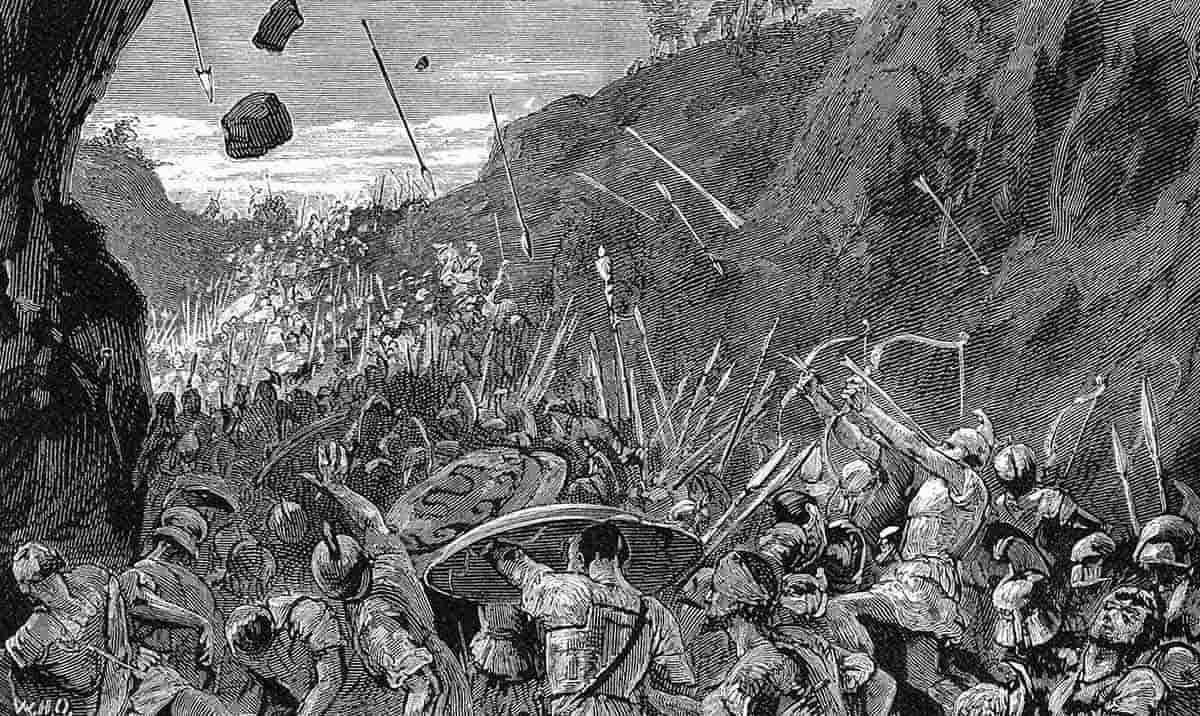
There was only one option left: retreat over land to the friendly city of Catana. The remaining force of soldiers, sailors, and non-combatants was still over 40,000 strong, but the road would be long and hostile. As the Athenians departed, leaving behind their dead and wounded, the Syracusans blocked the roads and mountain passes. Once again, the Syracusan cavalry haunted the Athenians with constant raids. Nicias, though still ill, did his best to encourage his men, but six days into the march, his column became separated from Demosthenes’ rearguard. When surrounded, Demosthenes had no choice but to surrender himself and his 6,000 men.
Nicias struggled on for two more days. When his thirsty soldiers reached the Assimarus River, they rushed to the banks to drink. There they were cut down by a merciless Syracusan attack. 18,000 died, and 7,000 were captured according to Diodorus (13.19). The fate of the prisoners was perhaps worse than that of the dead. Demosthenes and Nicias were executed. The prisoners not immediately sold into slavery were dumped into quarries outside Syracuse and fed starvation rations for months. It is said a few earned their freedom by reciting sections of the playwright Euripides, whom the Syracusans adored (Plutarch, Nicias 29.2). Most of the rest died slowly in the quarries.
The Athenian expedition, launched in 415 BC under controversy and with vague intentions, had ended in an unmitigated disaster. Tens of thousands died, and hundreds of ships were lost, along with the myth of Athenian superiority. The frozen war with Sparta was now hot again. The Peloponnesian War continued for another decade, but Athenian miscalculations had turned it from a struggle for supremacy to a fight for survival.
Sources
- Hanson, V. D. (2005). A war like no other: How the Athenians and Spartans fought the Peloponnesian War. Random House.
- Kagan, D. (1981). The Peace of Nicias and the Sicilian Expedition. Cornell University Press.
- Thatcher, M. (2024). “Thucydides, Segesta, and Leontini: Rethinking the Sicilian Expedition,” The Classical Quarterly (2024). 74.2
- Tritle, L. A. (2010). A New History of the Peloponnesian War. Wiley-Blackwell.