
The Seven Wonders of the Ancient World were a series of remarkable architectural achievements famous among ancient Greek travelers. The list of the original seven wonders was compiled by Antipater of Sidon in a poem written in the 2nd or 1st century BC:
“I have set eyes on the wall of lofty Babylon on which is a road for chariots, and the statue of Zeus by the Alpheus, and the hanging gardens, and the colossus of the Sun, and the huge labour of the high pyramids, and the vast tomb of Mausolus; but when I saw the house of Artemis that mounted to the clouds, those other marvels lost their brilliancy, and I said, “Lo, apart from Olympus, the Sun never looked on aught so grand.” Antipater of Sidon, Greek Anthology, 9.58
Overview of the Seven Wonders of the Ancient World
| Wonder | Location | Built | Status | Overview |
| Great Pyramid of Giza | Egypt | 2500 BC | Still Standing | The oldest and only surviving wonder, built for Pharaoh Khufu, stands 146.5 meters tall. |
| Hanging Gardens of Babylon | Iraq (Babylon) | Uncertain | Lost | Allegedly built by King Nebuchadnezzar II for his wife, featuring self-watering terraces. |
| Temple of Artemis at Ephesus | Turkey | 550 BC (rebuilt) | Destroyed | A grand temple dedicated to Artemis, rebuilt multiple times, and famously burned by Herostratus in 356 BCE. |
| Statue of Zeus at Olympia | Greece | 435 BC | Destroyed | A 12.5-meter-tall gold and ivory statue by Phidias, housed in the Temple of Zeus. It was destroyed in a fire in the 5th century CE. |
| Mausoleum at Halicarnassus | Turkey | c. 353-351 BC | Destroyed | A 45-meter-tall tomb built for Mausolus and Artemisia II, adorned with sculptural reliefs. It was destroyed by earthquakes in the 15th century. |
| Colossus of Rhodes | Greece | 294–280 BC | Destroyed | A 32-meter-tall statue of Helios, standing for only 54 years before being toppled by an earthquake. |
| Lighthouse of Alexandria | Egypt | c. 280 BC | Destroyed | An 110-meter-tall lighthouse on Pharos Island, one of the tallest ancient structures. It collapsed by the 14th century. |
1. Great Pyramid of Giza: The Only Surviving Ancient Wonder
The Great Pyramid of Giza in Egypt is the only ancient wonder still standing today. The pyramid, 145.6 meters tall, is a monumental tomb built around 2500 BC for Pharaoh Khufu. We are still not entirely sure how the 4,500-year-old structure, comprised of 2.6 million blocks of stone quarried from different locations, was built. In its heyday, the pyramid would have looked quite different, covered in white limestone and surmounted by a capstone in gold or electrum.
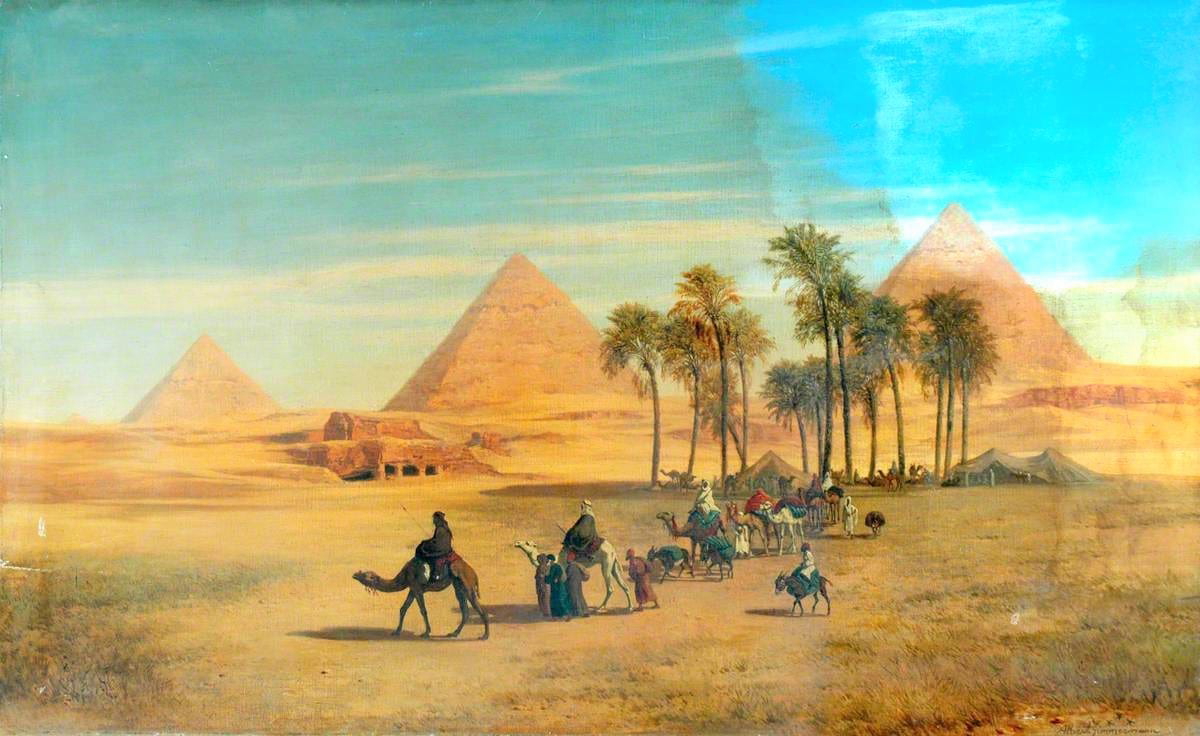
Khufu was a trendsetter with his pyramids, and his son Khafre and grandson Menkaure built their own pyramid tombs alongside the Great Pyramid. The tombs of the three kings have been attracting crowds of tourists since ancient times, from the Greek historian Herodotus in the 4th century BC to the Caliph Al-Ma’mun in the 9th century AD, who discovered the Great Pyramid’s ascending passage and its chambers.
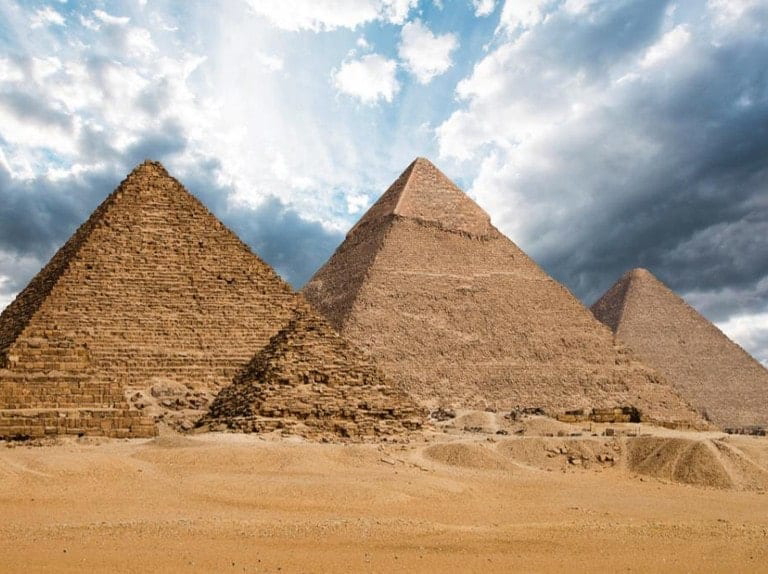
The Great Pyramid features two mortuary temples adjacent to the chambers where the Pharaoh and his wife were interred. Together, the pyramids and the Egyptian Sphinx attracted 15 million visitors in 2024.
2. Hanging Gardens of Babylon: The Unconfirmed Wonder
According to ancient sources, the Hanging Gardens were constructed by King Nebuchadnezzar II between 605 and 562 BC in the ancient city of Babylon, located in Mesopotamia. There was also an ancient legend that the mythical Queen Semiramis built the Gardens. As a result, they were also called the Gardens of Semiramis. The Gardens were a series of terraces containing fauna and flora. The most impressive thing about them, except for their size, was that they were self-watering, though it is not known for certain how this worked.
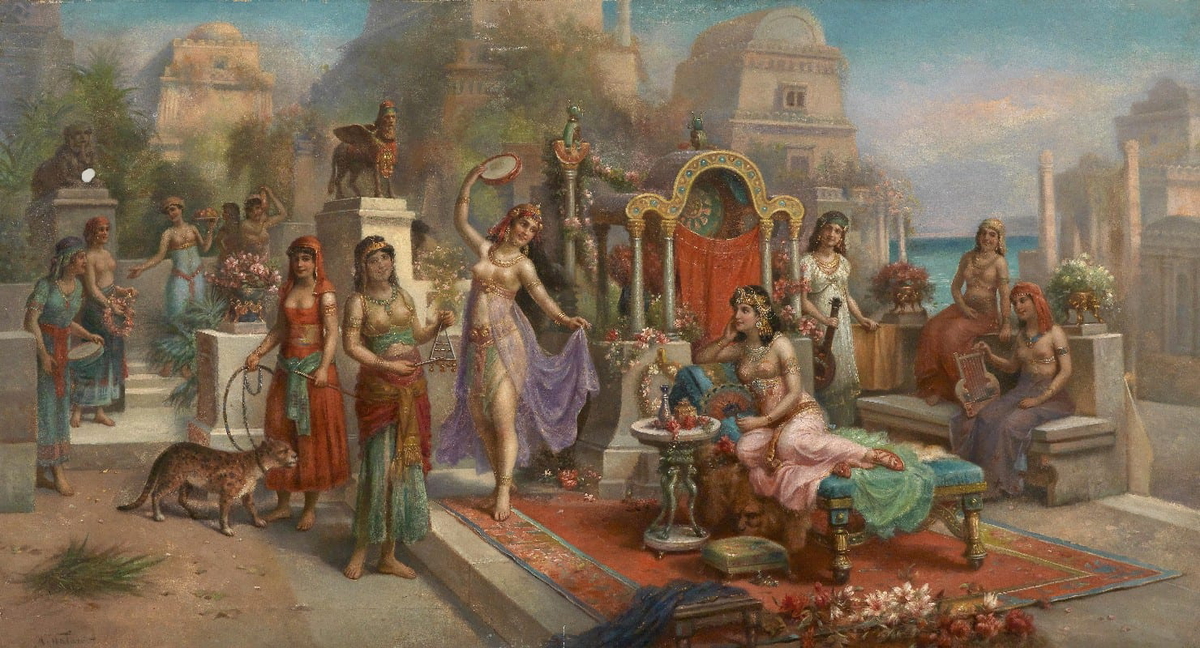
According to one legend, the Hanging Gardens were a gift from Nebuchadnezzar II to his wife Amytis of Media, who missed the green mountains of her homeland. The king ordered the construction of large artificial mountains filled with plants and trees to make the queen feel at home.
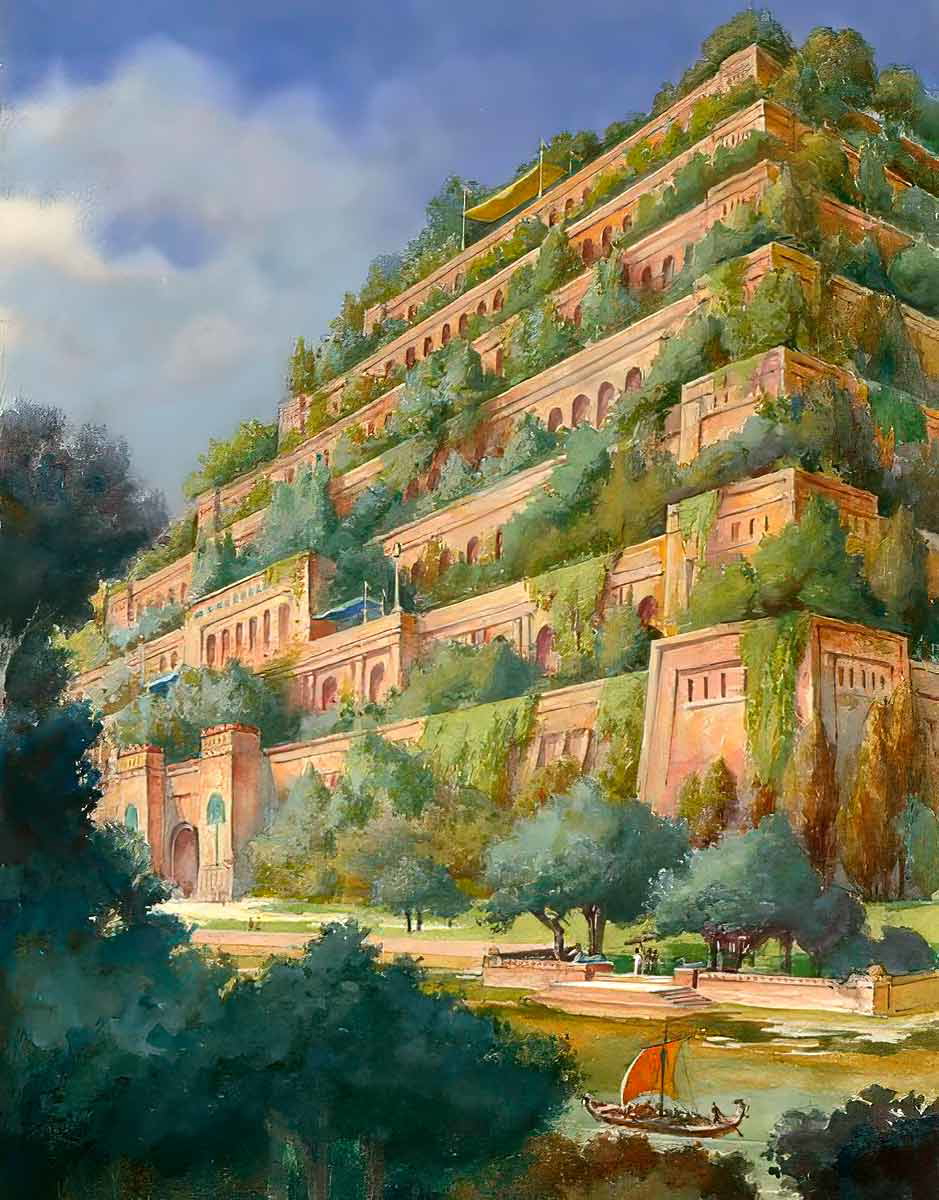
The existence of the Hanging Gardens of Babylon is disputed by historians because there is no archaeological evidence for the gardens, and they are not mentioned by other key historians, such as Herodotus. One theory by Oxford University Assyriologist Stephanie Dalley is that the gardens were actually built by Sennacherib at Nineveh. Dalley argues that earlier Akkadian inscriptions were misunderstood, confusing Nebuchadnezzar’s Babylon with Sennacherib’s Nineveh, because after the Assyrians took Babylon in the 7th century BC, Nineveh was referred to as the New Babylon. In contrast to Babylon, Sennacherib’s gardens were well-documented and are supported by archaeological finds.
3. Temple of Artemis at Ephesus: Destruction and Renewal
The Temple of Artemis or Artemiseion at Ephesus was a temple devoted to the cult of the Goddess Artemis, known as Diana among the Romans, and should not be confused with the Temple of Artemis in Corfu. The first Ephesian temple was destroyed in a flood at some point in the 7th century BC and was rebuilt in the 6th century BC. It is said that King Croesus of Lydia funded a great part of the temple’s reconstruction, which reached 115 meters in length and 55 meters in width.
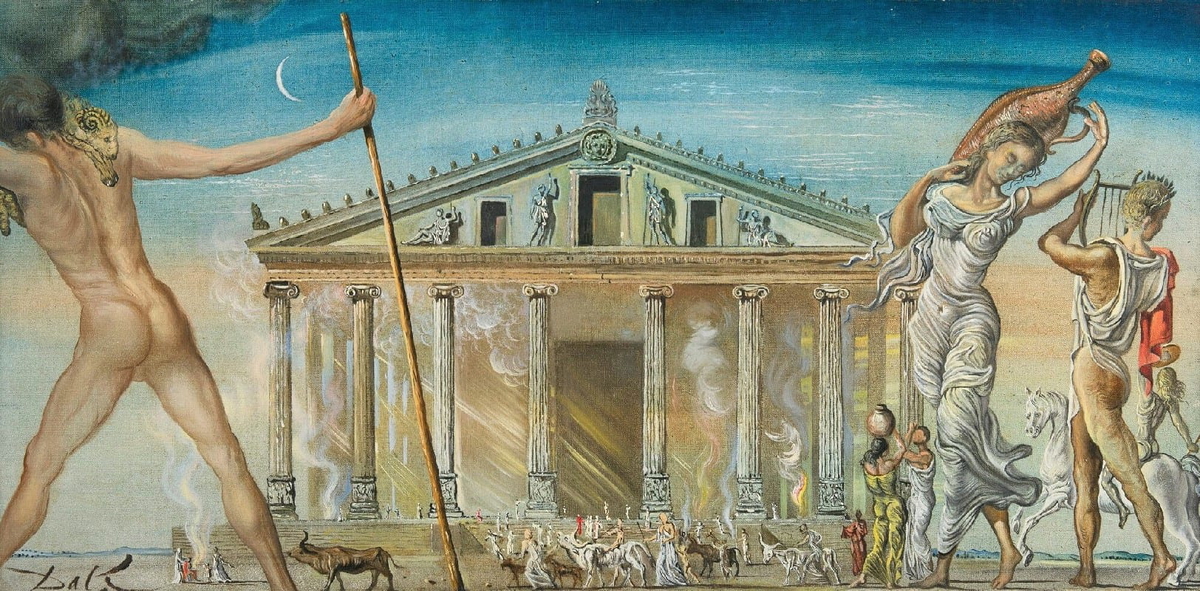
The second temple was burned in 356 BC by Herostratus, a man seeking fame through its destruction. His action triggered a damnatio memoriae (an official erasure of his memory from all records), but he still earned his spot in the history books.
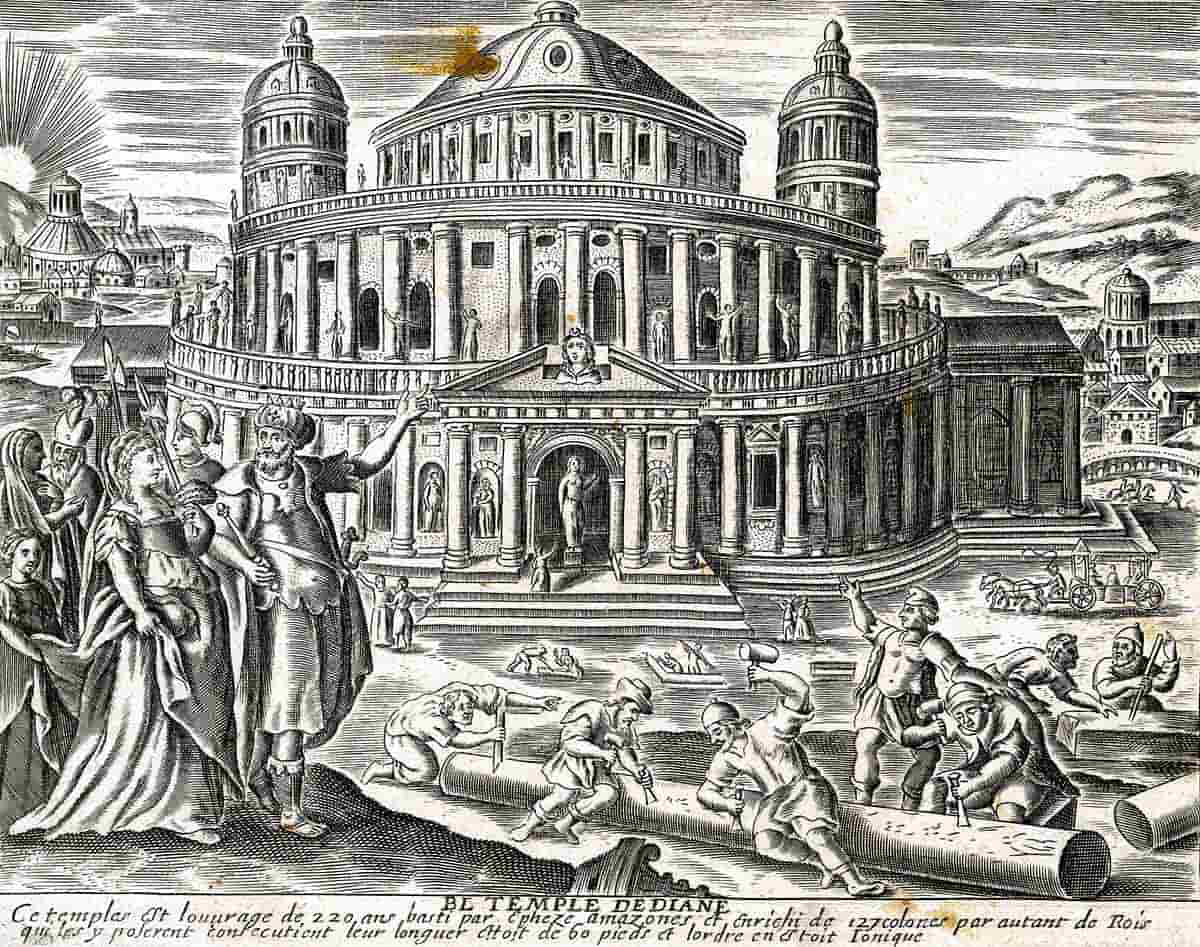
After Herostratus’ arson, the temple was rebuilt on an even more grandiose scale. It was this new version of the temple that was commemorated as one of the Seven Wonders of the Ancient World. It was the first complex structure in the Greek world to be made almost entirely of white marble. It was on a grand scale, with 127 Iconic columns each standing 60 feet tall. The temple measured roughly 377 feet long and 180 feet wide. The architect, Chersiphron, deliberately chose marshy ground to cushion the massive marble structure against regional earthquakes. To create a stable foundation, workers laid down layers of packed charcoal and sheepskins before laying stone.
This temple was badly damaged again by Gothic raiders in AD 262, but was finally destroyed by a Christian mob led by John Chrysostom in AD 401.
4. Statue of Zeus at Olympia: A Divine Monument
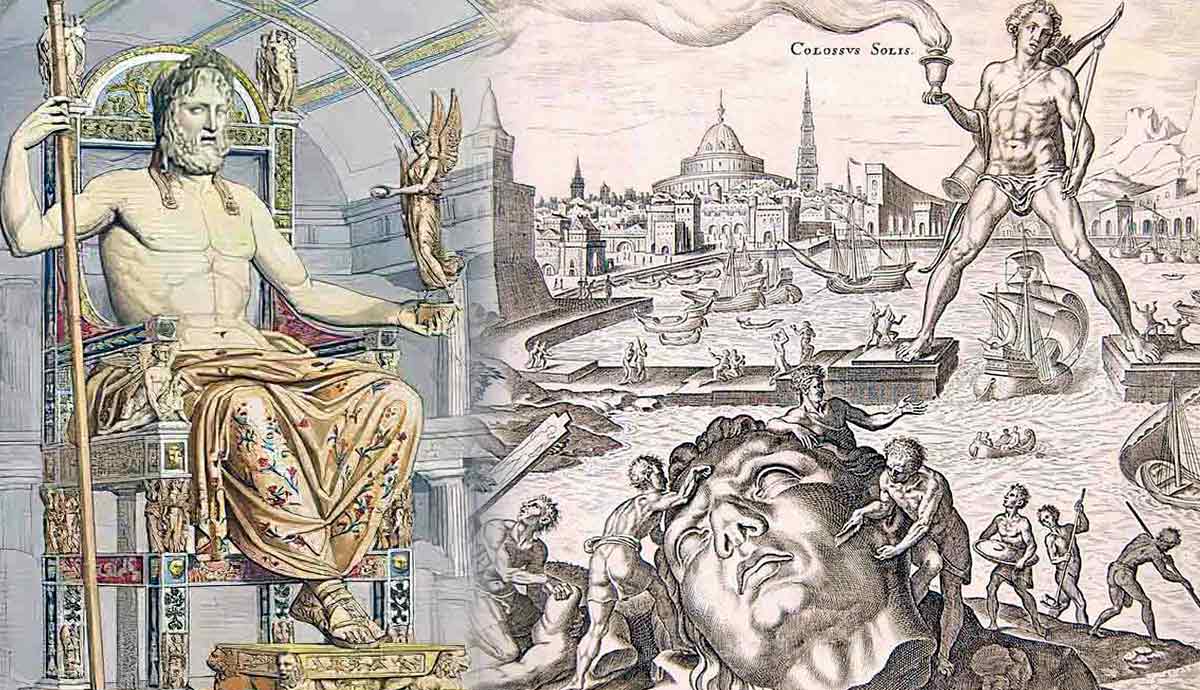
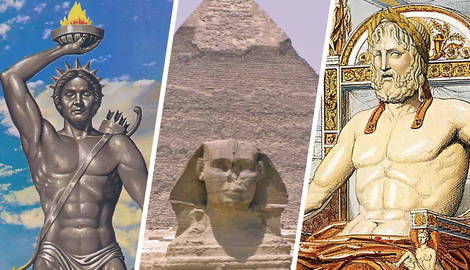
Phidias, one of antiquity’s greatest sculptors, created the statue of Zeus at Olympia around 435 BC. The statue, made of gold and ivory, depicted the father of the gods, Zeus, enthroned, holding the sculpture of the victory goddess Nike and a scepter topped with an eagle. The statue was placed inside the temple of Zeus at Olympia. Standing almost 12.5 meters tall, people joked that if Zeus wanted to stand up, he would hit his head on the ceiling. In front of the statue was a reservoir filled with oil. It helped preserve the statue by balancing the humidity levels inside the room.
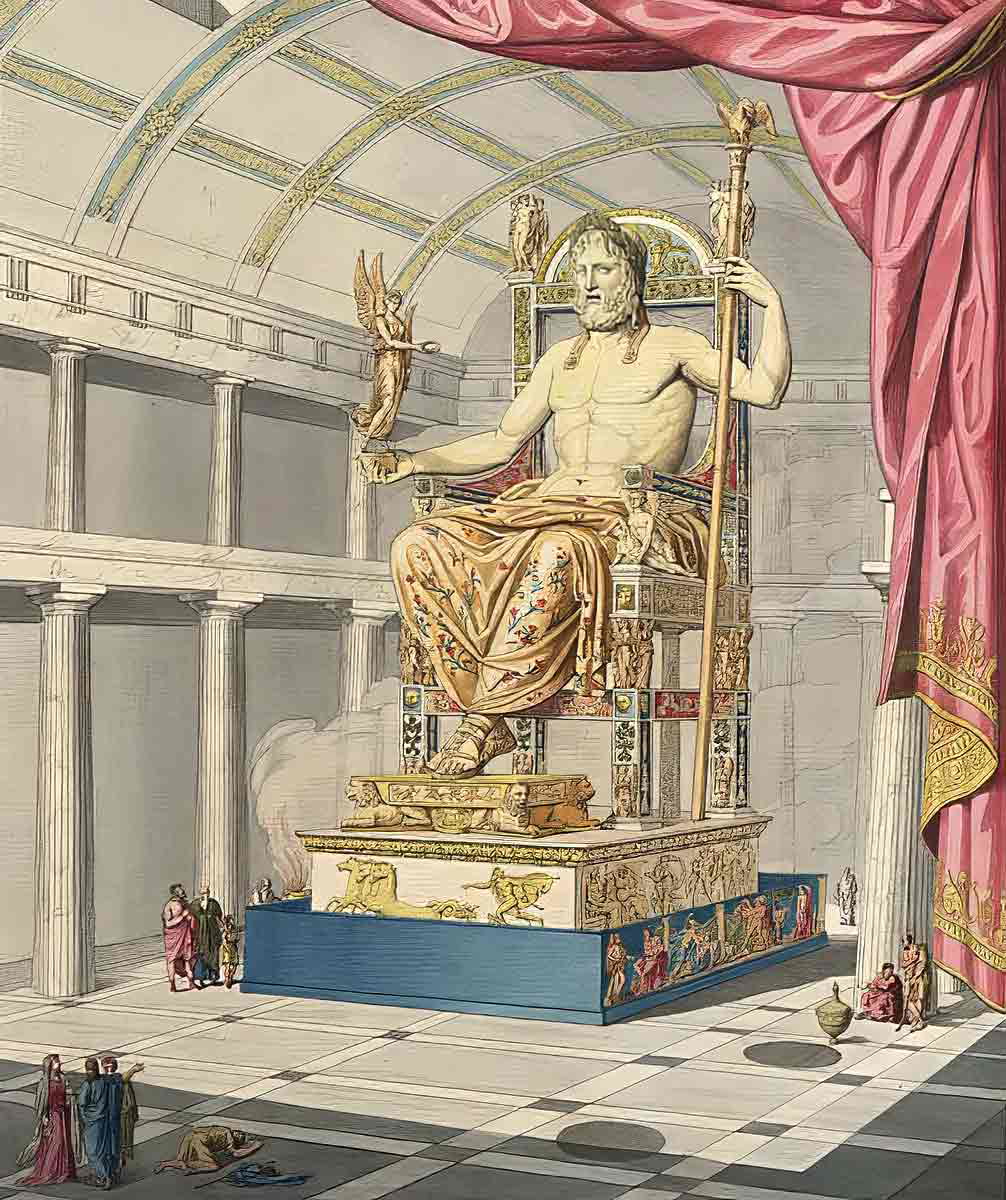
Allegedly, the Roman emperor Caligula wanted to transport the statue to Rome and have Zeus’ head replaced with his own. Caligula’s death in AD 41 was a twist of luck that allowed the statue to survive a bit longer. Eventually, it was moved to Constantinople, where it was destroyed in a fire in the 5th century AD. Hypothetical reconstructions are based on ancient descriptions.
5. Mausoleum at Halicarnassus: A Posthumous Legacy
Just like the pharaohs of Egypt built monumental pyramids as their tombs, a Persian satrap of Caria named Mausolus decided to construct a lavish tomb for himself, his sister, and his wife, Artemisia II. The Mausoleum of Halicarnassus was built between 353 and 351 BC and would have been around 45 meters tall. It was the work of the Greek architects Satyros and Pythius of Priene. Four famous Greek sculptors, Leochares, Bryaxis, Scopas, and Timotheus, decorated the four sides of the massive structure with sculptural reliefs.
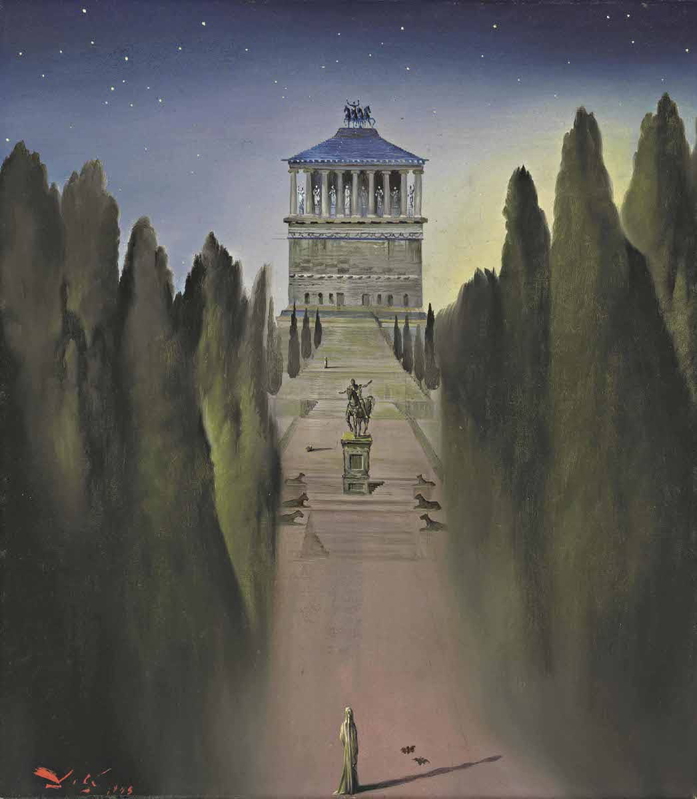
Artemisia continued the work after Mausolus’ passing, but also died before the monument was finished. In the end, the architects and sculptors agreed to finish the work, thinking that this was not simply a tomb for the rulers of Caria but also a monument to their own art. The Mausoleum was the second-longest surviving ancient wonder, destroyed after a series of earthquakes in the 15th century.
It included a variety of design elements. The main structure combined Lycian base blocks, a Greek colonnade of 36 Ionic pillars, and an Egyptian stepped-pyramid roof consisting of 24 steps. At the peak of the pyramid roof sat a colossal marble quadriga; a four-horse chariot carrying marble statues of Mausolus and his wife Artemisia. Each of the structure’s four sides was assigned to a different leading Greek sculptor to carve intricate life-sized reliefs of battling Amazons and Centaurs.
6. Colossus of Rhodes: The Shortest-Lived Wonder
As the name suggests, the Colossus of Rhodes was a colossal statue of the god Helios (Sun) on the island of Rhodes. The sculptor Chares of Lindus created this 32-meter-tall monument over 12 years between 294 and 282 BC to celebrate Rhodes’ successful survival of a siege by Demetrius Poliorcetes. When Demetrius fled, he left behind expensive siege equipment, which the Rhodians sold to fund the construction.
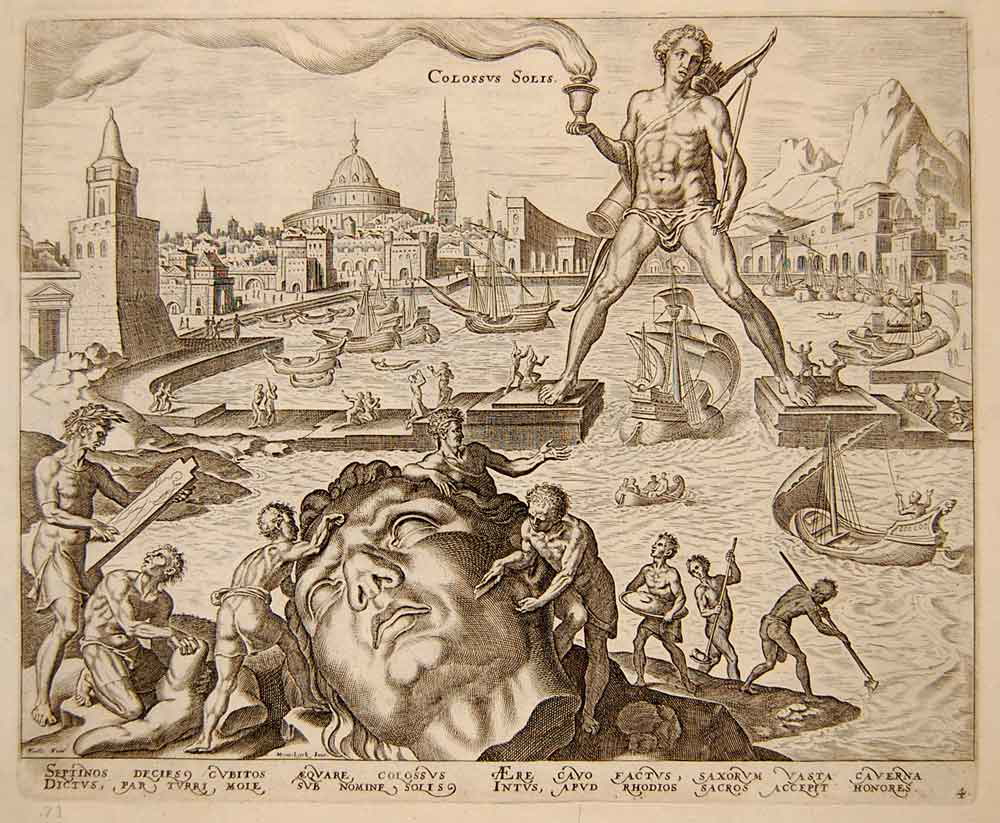
The Colossus was so large that it was soon toppled by an earthquake around 225/226 BC, making it the shortest-lived wonder, standing for just 54 years. King Ptolemy III of Egypt offered to fund rebuilding the statue, but after consulting the Oracle at Delphi, the Rhodians refused the offer. The ruins were left in place until the Arab invasion of AD 654. The invaders used the statue’s remnants as a source of bronze, which took 900 camels to transport. The statue was the tallest sculpture in the ancient world and a common theme in the Rhodians’ coinage.
While modern depictions often show the colossal statue straddling the harbor, this would have been impossible as the statue would have collapsed under its own weight. It almost certainly stood on one bank and looked out over the harbor.
7. Lighthouse of Alexandria: A Beacon of Progress
The Lighthouse of Alexandria was built at some point around 280 BC in the newly founded Egyptian city of Alexandria, named for the conqueror Alexander the Great, which became the capital of Hellenistic Ptolemaic Egypt. The building was the work of Sostrates of Cnidus. Standing on the island of Pharos (which means lighthouse in Greek), if estimates are correct, it surpassed 110 meters, making it the second-tallest building of its time after the Great Pyramid of Giza.
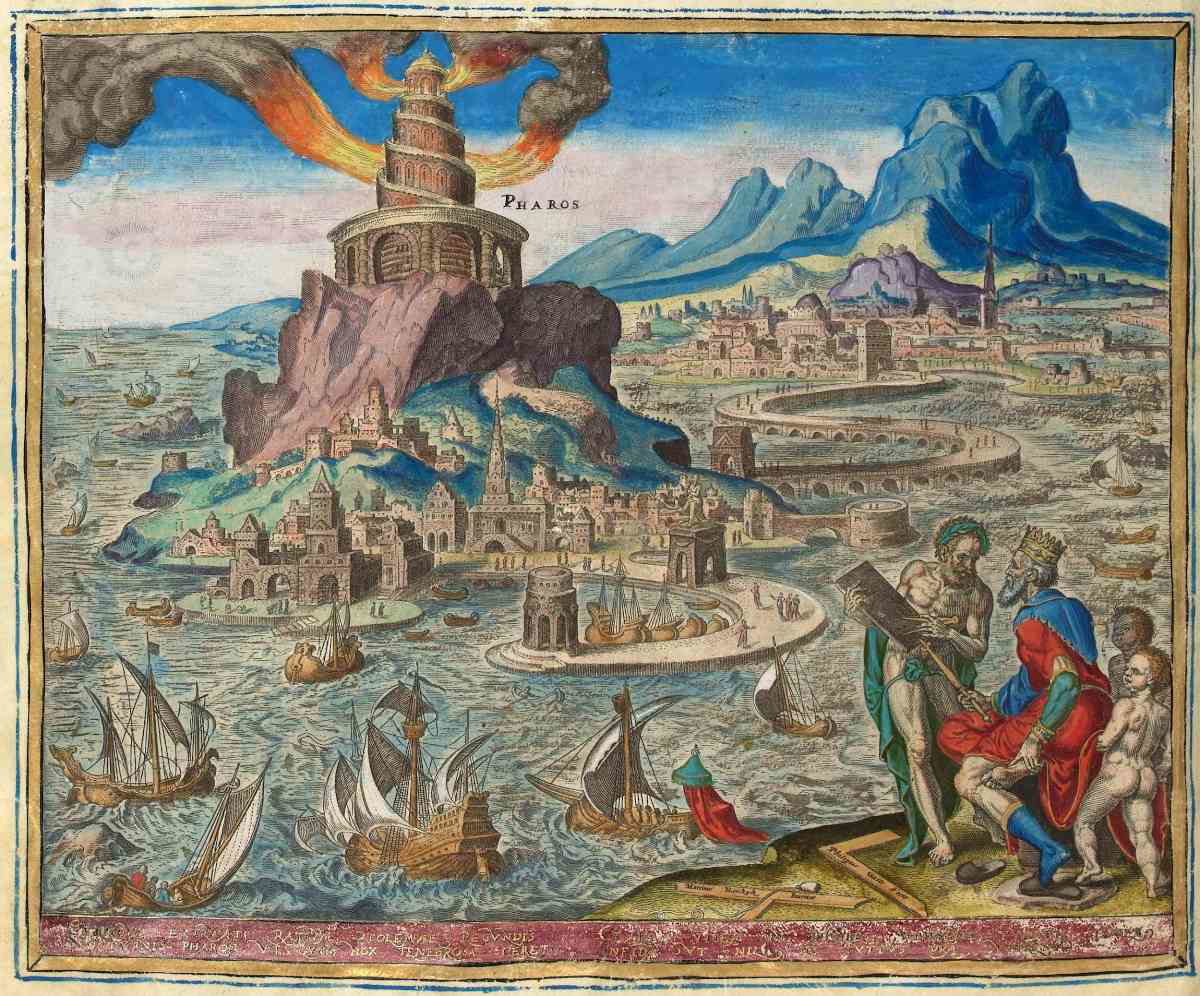
The Lighthouse was built in three stages, with a fire burning on the top. It is also quite possible that there was a colossal statue of Alexander the Great, Ptolemy I Soter, or the god Helios standing on top of the building. The lighthouse was still in place in the 12th century AD. It is said that Ahmad ibn Toulon replaced the beacon with a mosque. However, the monumental building collapsed by the 14th century, and around 1480, its ruins were used in the construction of the Citadel of Qaitbay.
Why Were They Called Wonders?
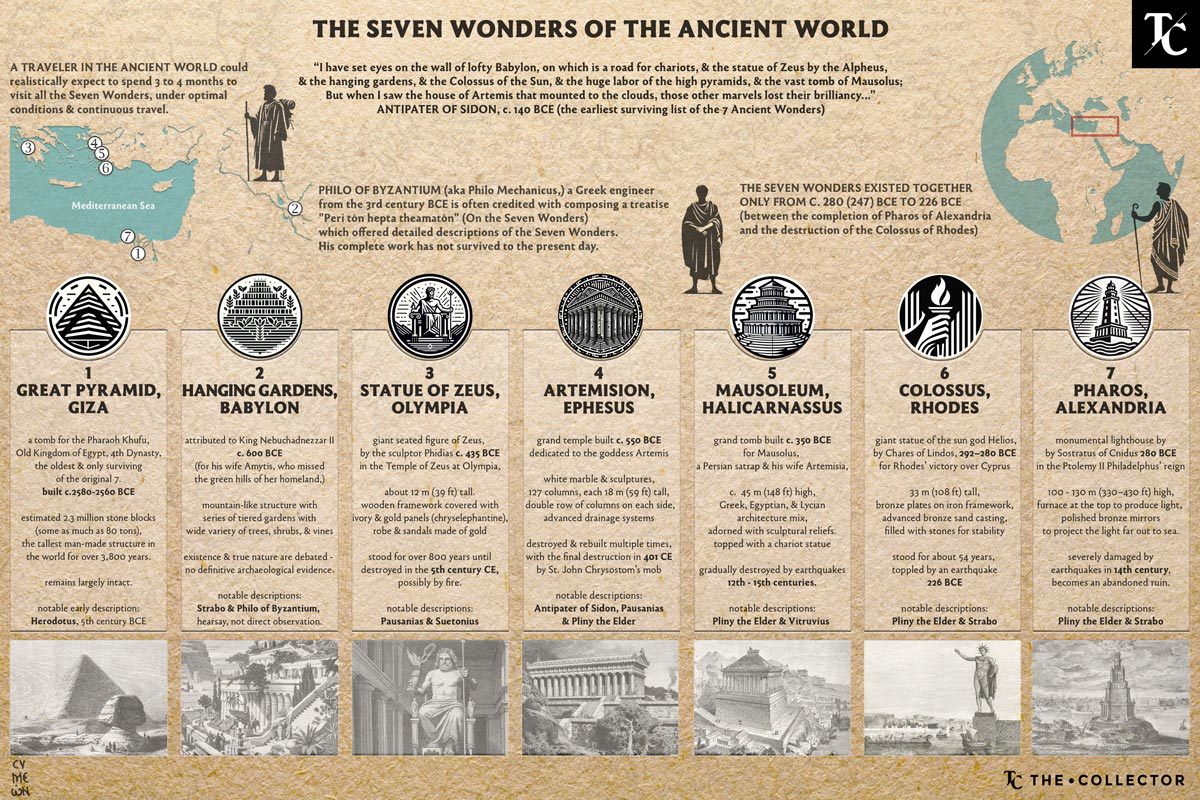
During the Hellenistic period, the known world (the Mediterranean and the Middle East) was opened to Greek travelers. Greek travelers began recording their journeys and compiling lists of impressive monuments they encountered. These must-see destinations were initially known as “theamata” (sights) and eventually as “thaumata” (wonders).
With time, the lists were limited to seven wonders, as the number seven represented perfection and completeness. Each traveler had their own individual list based on the places they visited, so some alternative lists exist. For instance, some included the walls of Babylon, while others replaced them with the Lighthouse of Alexandria or, later, even the temple of Solomon in Jerusalem.
Who Wrote the List of the Seven Wonders?
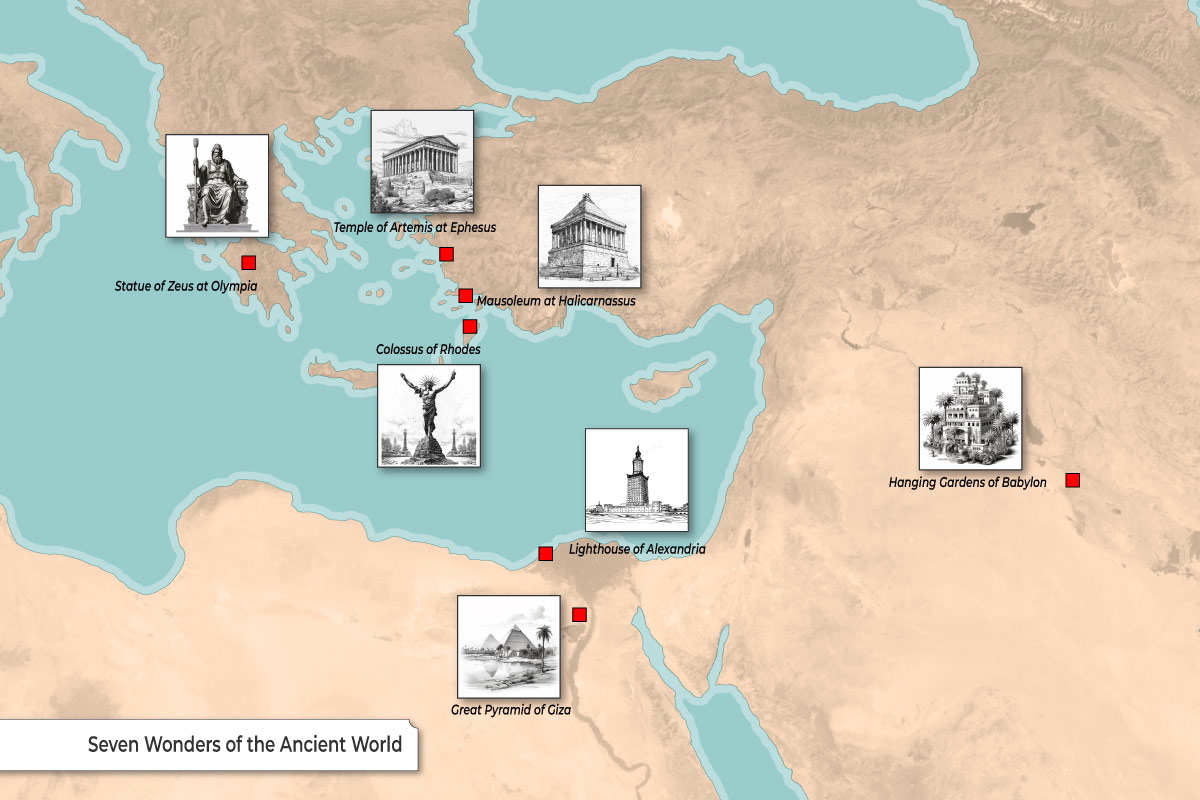
Herodotus (5th century BC) and Callimachus of Cyrene (3rd century BC) were the first to compile lists of Seven Wonders. However, their lists were not preserved. As a result, the list of monuments that we now recognize as the Seven Wonders of the Ancient World belongs to Philo of Byzantium (3rd century BC) and Antipater of Sidon (around 2nd century BC).
Was It Ever Possible to See All the 7 Wonders of the Ancient World?
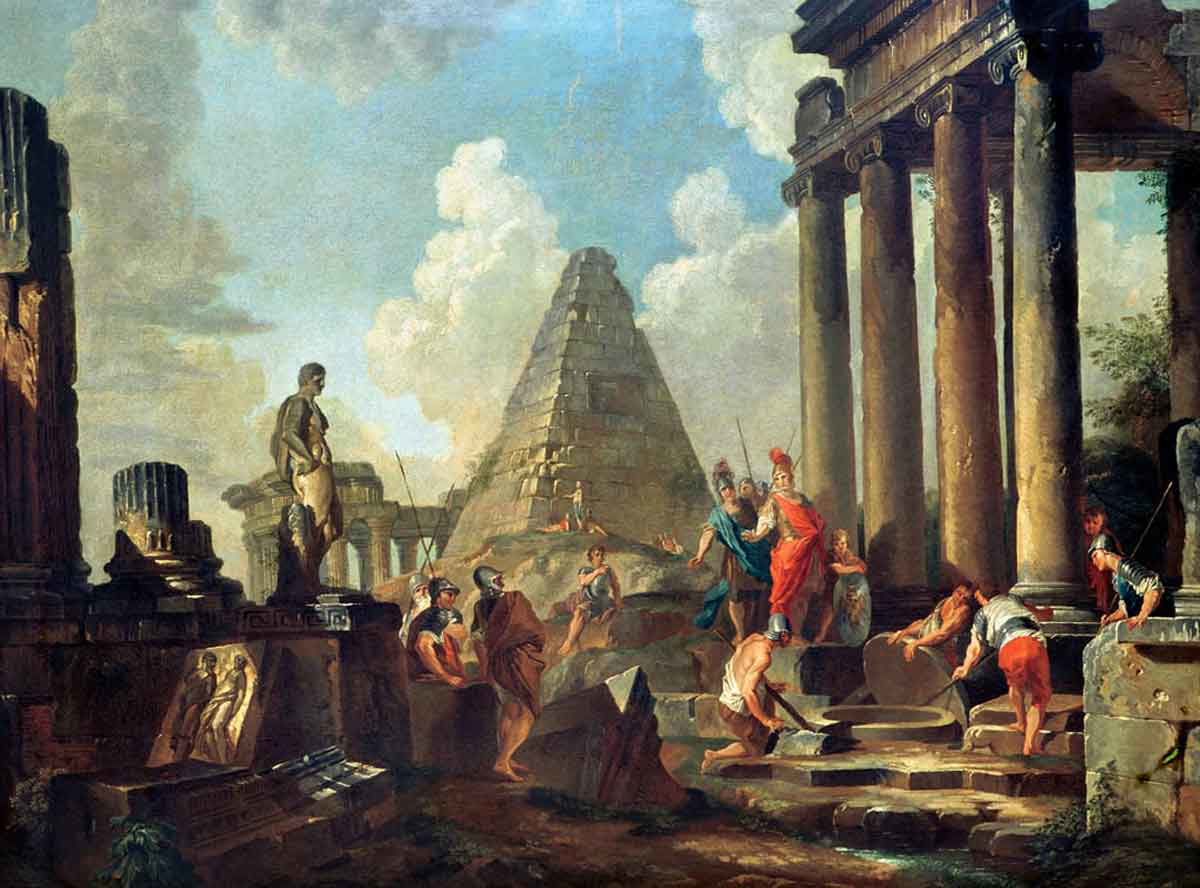
Assuming the gardens in Babylon really existed, would it ever have been possible for an ancient traveler to see all seven wonders of the ancient world in their lifetime? Yes. While the Colossus of Rhodes only stood for 54 years, ancient travelers were happy to visit the ruins of the monumental statue. That means that all seven wonders could have been visited between when the Colossus of Rhodes was erected in 280 BC and the final destruction of the Temple of Artemis in AD 262.
Legacy of the Wonders of the Ancient World
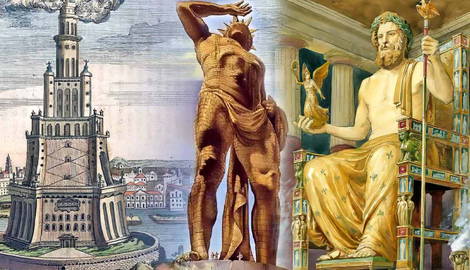
The idea of the seven wonders proved influential, and many subsequent writers compiled their own lists based on their respective culture, education, and geographic location. For example, in the 2nd century AD, when Rome was the center of the known world, the Roman poet Martial added the Colosseum of Rome to his list. Christian writers, notably Gregory of Tours in the 6th century AD, added the temple of Solomon in Jerusalem and Noah’s Ark, and made lists of natural wonders.
Multiple lists appeared during the 19th and 20th centuries. Monuments like the Kom-El-Shoqafa in Alexandria, the Hagia Sofia in Istanbul, and the Great Wall of China were listed as the Seven Wonders of the Medieval World, while Mount Everest and the Grand Canyon were featured in lists of the Seven Wonders of the Natural World.
The New Seven Wonders of the World
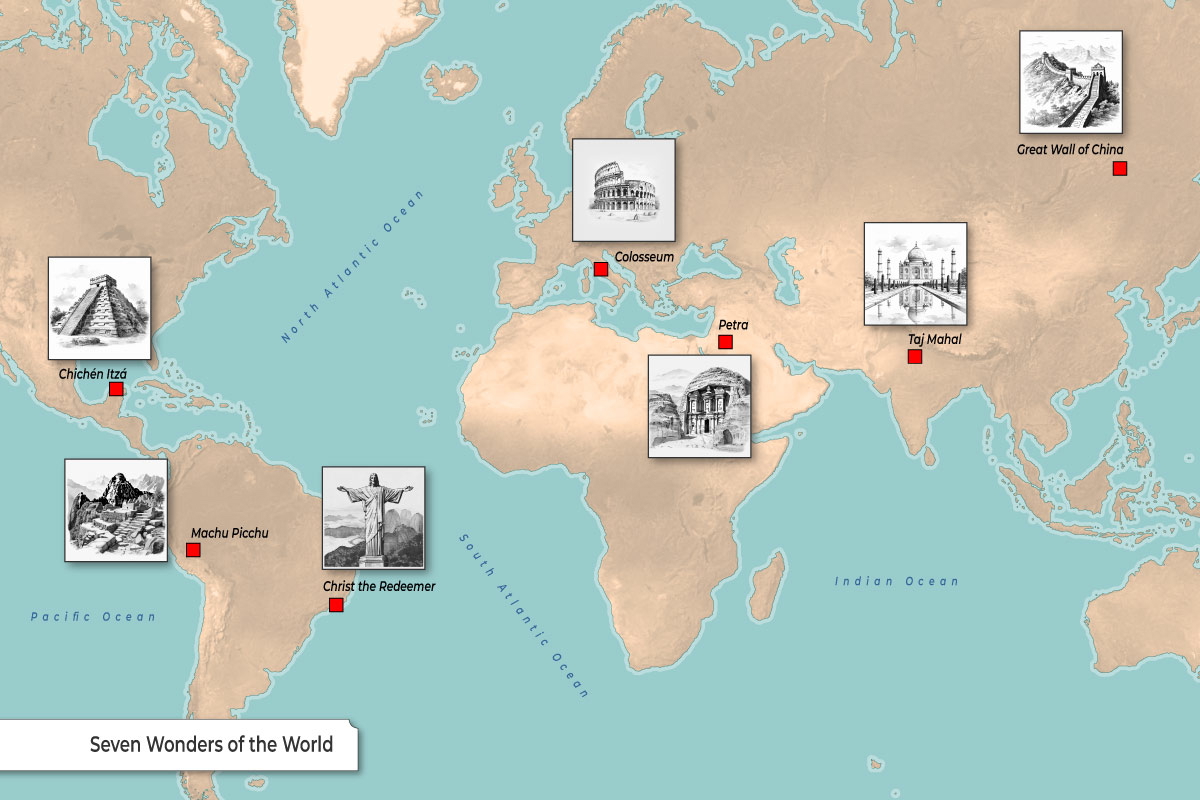
In 2001, the Swiss NewWonders Foundation compiled a list of the New Wonders of the World through an online vote. The only ancient wonder that made it into this new list was the Pyramid of Khufu. Interestingly, the Pyramid was not voted in but was added as an honorary entry. The list included the following seven wonders of the modern world:
- The Colosseum, Italy
- The Great Wall of China
- The Taj Mahal, India
- Christ the Redeemer, Brazil
- Machu Picchu, Peru
- Chichén Itzá, Mexico
- Petra, Jordan
The same foundation has also compiled a list of the New Seven Wonders of the Natural World, and multiple lists focus on different areas, such as the wonders of modern engineering and the solar system.
We extend our sincere gratitude to archaeologist T. Matanis for his invaluable contribution to the (AI) reconstruction videos, which offer a captivating glimpse into the lost grandeur of the seven ancient wonders of the world.